Eco Friendly
Real or Artificial Christmas Tree: The Ten-Year Sum on Cost, Mess and Carbon
A real Christmas tree or an artificial one? The fake only wins if you keep it about a decade, the real one only if it is mulched. The sum, and the fire safety.

An artificial Christmas tree is the greener and cheaper choice only if it stays in the family for a decade or more. A real tree is the greener choice only if it ends up as mulch rather than landfill.
Everything else said on the subject is marketing, and both camps do it. The plastic tree is sold as “reusable”, which it is, for exactly as many years as you reuse it. The real tree is sold as “natural”, which it is, right up until it rots in a tip. Neither word settles anything.
One number does: years of use.
The carbon side, and its limits
The most quoted figures come from the Carbon Trust, as reported by Euronews and the Big Issue. They are UK estimates, for a tree about 2 metres tall.
- An artificial tree: about 40 kg of CO2.
- A real tree without roots, chipped or burnt after Christmas: about 3.5 kg.
- The same real tree sent to landfill: about 16 kg, mostly from the methane it gives off as it rots.
On those UK numbers, the reported break-even for the artificial tree is roughly ten to 20 Christmases of use. Keep it for fewer years than that and the real tree, properly disposed of, comes out ahead.
That range is wide. Ten years is a long time to keep anything made of plastic, and 20 is a long time to keep anything at all. A buyer who wants the artificial tree to be the greener choice should plan on the far end of the range, not the near one. Planning on the near end is how the sum gets fudged.
These are UK studies. Australian freight, Australian farms and an Australian summer will shift every figure on that list, and nobody should quote them as local numbers. The shape of the answer holds anyway. The artificial tree is a large carbon cost paid once. The real tree is a small one paid every year, more than four times larger on the UK figures after a bad exit.
None of this makes either tree carbon neutral. It only decides which one costs less.
The money side, as a method
Prices are useless here. They change by city, by year and by the week before Christmas. The method does not.
For a real tree, take this year’s price and multiply it by the number of years you will keep buying one. That is the cost.
For an artificial tree, take the purchase price and divide it by the number of Christmases it survives in your house, not the number implied by the box. Then add the cupboard, garage shelf or spare-room corner it occupies for eleven months of the year. That space is already being paid for, in rent or in mortgage.
The trap sits in the second sum. A cheap artificial tree that goes flat, sheds plastic needles and gets thrown out after three years costs more per Christmas than the buyer assumed, and it lands in landfill carrying its whole carbon bill. The tree thrown out after three years is the most expensive tree in the room.
Run both over ten years and the comparison gets simple. The real tree is ten purchases. The artificial tree is one purchase if it lasts, and two or three if it does not. How well it is made decides which. The cheapest artificial tree in the shop is not automatically the cheapest tree over a decade.
Put three households side by side, as an illustration. No prices, just counts, and the carbon on the Carbon Trust’s UK estimates.
Household one buys a real tree every December for ten years and has it chipped every January. That is ten purchases at about 3.5 kg of CO2 each, so roughly 35 kg across the decade. Slightly less than one artificial tree. Send those same ten trees to the tip instead and it is about 160 kg. The exit is the whole difference.
Household two buys a solid artificial tree and keeps it the full ten years. One purchase, about 40 kg, paid in year one. Close to level with household one on carbon, and the cost sits on a single receipt.
Household three buys the cheap artificial tree, bins it after three years, and does the same again twice more. Three purchases, about 120 kg, and three trees in landfill. Every box said reusable, and every tree was, for three Christmases. Worst on every line, and the household paid for the privilege three times.
This is the same multi-year sum that decides most purchases worth arguing about. A car is the obvious example: the long-term value of an electric vehicle against a fuel vehicle comes down to how long the car is kept. A Christmas tree is a smaller version of the same question. Divide by the years.
The mess and the heat
Real trees in a 35-degree December drop needles. They need water every day and dry out if they do not get it. Anyone who has vacuumed pine needles out of a rug in February knows the drill.
This is the part the northern-hemisphere studies never have to deal with. A pine tree in a cold European living room in December is in its element. A pine tree in a Brisbane lounge room in December is not. The heat does not change the carbon sum, but it changes how much work the tree is and how long it looks good.
Artificial trees collect dust. They need storage. They come in a box that never quite fits back into itself, and the box needs a shelf of its own.
Neither is clean. The real tree is messier in December. The artificial tree is a nuisance for the other eleven months. Pick the mess you mind least.
Most households do not have this argument with a spreadsheet. They have it with each other. One person wants the smell of a real pine in the house. The other remembers last year’s needles in the rug and a tree going brown before Christmas Day, and points at the box in the garage.
Both are right about their half. Real ones are nicer. Fake ones are easier. Neither point is about carbon or money, so neither settles anything. Settle the sum first: how many years, and which exit. Then argue about the smell.
Buying a real tree that lasts to Christmas Day
The usual complaint about real trees is that they are dead before the 25th. Queensland Fire and Emergency Services covers the basics on its Christmas tree information sheet, and its checklist starts at the point of sale, which is the right place.
- Look for fresh, green needles that do not fall off when touched.
- Cut 2 cm off the base of the trunk before it goes into the stand.
- Add water every day.
- Dispose of it after Christmas, or as soon as it dries out.

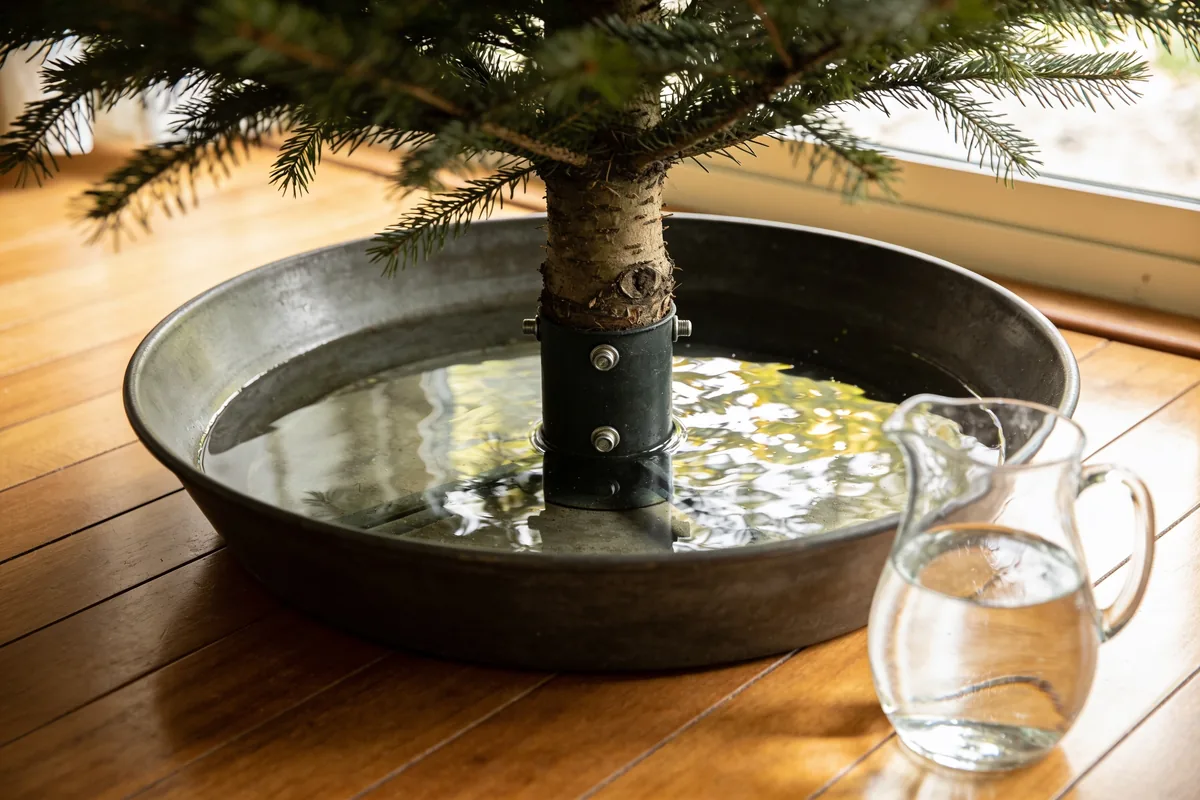
The needle test is quick. Run a hand along a branch. If needles come away, walk on.
The fresh cut matters because the tree has to drink, and the 2 cm comes off before it goes in the stand, not after a day leaning against the garage wall. Then the water goes in, and keeps going in, every day.
The last point on the list is about safety, not looks. QFES warns that dried-out trees are highly flammable. A brown tree in a hot house is a fire risk with tinsel on it. Once it dries, it goes, whatever the date.
Lights and placement, whichever tree
Fire risk does not belong to the real tree alone. Lights and candles do the damage on either kind. The QFES advice:
- Keep the tree at least one metre from heat sources such as candles.
- Do not let it block an exit.
- Use lights that are compliant with Australian standards.
- Replace worn light strings.
- Do not overload power outlets.
- Never put lit candles on the tree.
- Turn the lights off before going to bed or leaving home.
None of this changes between plastic and pine. A tree that blocks the hallway is badly placed whatever it is made of. A string of lights with a frayed lead is a bad string of lights on any tree. The old set that has come out of the same box for years deserves a proper look before it goes back up.
After Christmas: the disposal decides the carbon
This is where the real tree wins or loses. Chipped, the UK estimate is about 3.5 kg. Landfilled, about 16 kg. Same tree, same farm, same Christmas. The difference is made in the first week of January.
QFES suggests recycling the tree as garden mulch. Many councils collect trees after Christmas, or take them in the green-waste bin if they are cut to size. The rules and dates vary from council to council, so check your own before the tree goes out to the kerb. A real tree that misses the collection and goes in the general rubbish has just made the artificial tree look better.
The order of priorities is the one InkNest has applied to household waste before: reuse first, then recycle, with landfill last. For an artificial tree, reuse means keeping it, for years, and passing it on rather than binning it when the household wants a change. For a real tree, recycling means mulch. Landfill is the worst outcome for both.
There is a third option, briefly. A potted living tree comes inside for December and goes back outside for the rest of the year. It suits a household with the space, the patience and a plant that survives being moved. It is still subject to the same sum, run over however many years it lives.
Keep it ten years or buy it fresh
The verdict stands.
Buy an artificial tree only if it is built to last, and only if you will keep it for ten Christmases or more. Buy a cheap one, throw it out after three, and it is the worst choice on cost and carbon alike.
Buy a real tree only if it will be mulched. Choose it on the needles, cut the base, water it daily, keep it a metre from heat and get it out of the house once it dries.
The carbon figures are UK estimates and Australian conditions will move them. The decision they point to does not move. Count the years, plan the exit, and ignore the labels on both.
Sources: Christmas tree information sheet, Queensland Fire and Emergency Services (https://www.fire.qld.gov.au/sites/default/files/2021-05/ChristmasTreeSafety.pdf); Are real or artificial Christmas trees better for the environment?, Euronews, citing the Carbon Trust (https://www.euronews.com/2023/12/23/fact-check-are-real-or-artificial-christmas-trees-better-for-the-environment); Real Christmas tree or artificial Christmas tree, Big Issue, citing the Carbon Trust (https://bigissue.com/news/environment/real-christmas-tree-or-artificial-christmas-tree-your-environmental-guide-to-the-december-dilemma)