Family & Parenting
The Law Lets a Child Leave the Booster Seat at Seven, but Most Do Not Fit a Seatbelt Until 10 to 12
The law lets a child leave the booster seat at seven. Most children do not fit an adult seatbelt until 10 to 12. State rules, the five-step test and the review.

The birthday is coming, and you have started doing the sums. Seven means the booster comes out, doesn’t it? A few of the other children are already travelling on the seatbelt alone, your child has mentioned it twice this week, and somewhere under your cheerful “we’ll see” sits a small private question: am I overdoing this?
You are in good company, and the answer is a kind one. Leaving a booster seat at seven breaks no law in most of the country, and keeping your child in one for longer is a sensible choice that the official advice backs. The law marks the earliest point a child may leave. The official advice from the states and the National Transport Commission (NTC) marks the point where most children fit, and for most that is somewhere between 10 and 12.
Below you will find the rules state by state, where the number seven came from, a five-step test you can do in your own car, and a plain account of what is under review and what has not changed.
What the law says, state by state
Every jurisdiction uses the same age, but each words it differently, and the wording matters. Here is each official page set beside its own advice. Quotation marks mean the words are the page’s own.
| Jurisdiction | What the law allows from 7 | What the official page recommends |
|---|---|---|
| NSW | The legal minimum age for leaving a booster is 7 (Transport for NSW) | Five-step test |
| Victoria | Rule 266A(5), Road Safety Road Rules 2017, quoted in the coronial finding: 7 to under 16 may use an approved restraint, a booster with belt, or a seatbelt | Safest to stay until good belt fit, around 10 to 12 (TAC); belts designed for 145 cm and over (Better Health Victoria) |
| Queensland | “Legally, children aged 7 and up can sit in a normal seat with an adult seatbelt and can travel in the front seat” (Queensland Government) | Stay until shoulders pass the top marker; back seat until 12; most children not big enough until 11 or 12 |
| South Australia | 7 up to 16: an approved restraint, or a properly adjusted and fastened seatbelt (SA.GOV.AU) | Restraint to match age and size |
| Western Australia | Seatbelts page: children aged 7 and up “must use a child restraint unless they can wear an adult seatbelt properly”; Road Safety Commission parents page says they “should remain in a suitable child restraint until” they pass all five steps | Five-step test |
| Tasmania | 7 and older: a properly fastened forward-facing seat or adult seatbelt (Department of State Growth booklet, December 2019) | Continue in a booster until tall enough; most need one to 10 to 12 |
| ACT | Under 7 must use an approved restraint; 7 or older “should continue to use a child restraint suitable for their size” (Access Canberra) | Suggested minimum 145 cm and five-step test |
| NT | Under 7 must use an approved restraint or booster; the NT page says passenger seats “can be used by children older than 7 years of age who have outgrown their car seat” | Back seat first |
The middle column shows different sentences about one birthday. Queensland says “legally”, and Western Australia words it around whether an adult seatbelt can be worn properly. The right-hand column is much tighter: every page points to fit rather than age.
If your state’s wording seems harder to read than it should be, you have plenty of company, and the right-hand column is the one to follow. This is general information, so check your own state’s page before you decide.
Why the number is seven
Knowing where seven came from takes some of the sting out of the gap. The NTC’s 2025 issues paper explains that the age was set when booster weight limits of 26 kg left about a third of children over seven outside them.
Seats have moved on since. The NTC notes that boosters now go to about 8 (type E8) or about 10 (E10 and F). The law is a floor set in an older era, and the seats have since moved past it. When you keep your child in a booster, you are using what the seats can now do.
Age and readiness part ways in other parts of a child’s life too. Our guide to swimming lessons by age covers another place where the number on the birthday cake and the child in front of you do not always match.
The five-step test, in the car you drive
This part is for doing rather than reading. The five steps appear on the Transport Accident Commission, South Australian, Western Australian and Tasmanian pages and in the NTC paper. Do it with your child sitting in the car you use, because the NTC points out that fit differs between cars, since rear seats and belts differ.
With your child seated normally and no booster, check five things:
- Their back sits all the way against the seat.
- Their knees bend comfortably over the front edge of the seat.
- The sash runs across the middle of the shoulder.
- The lap belt lies across the top of the thighs.
- They can stay that way for the whole trip.

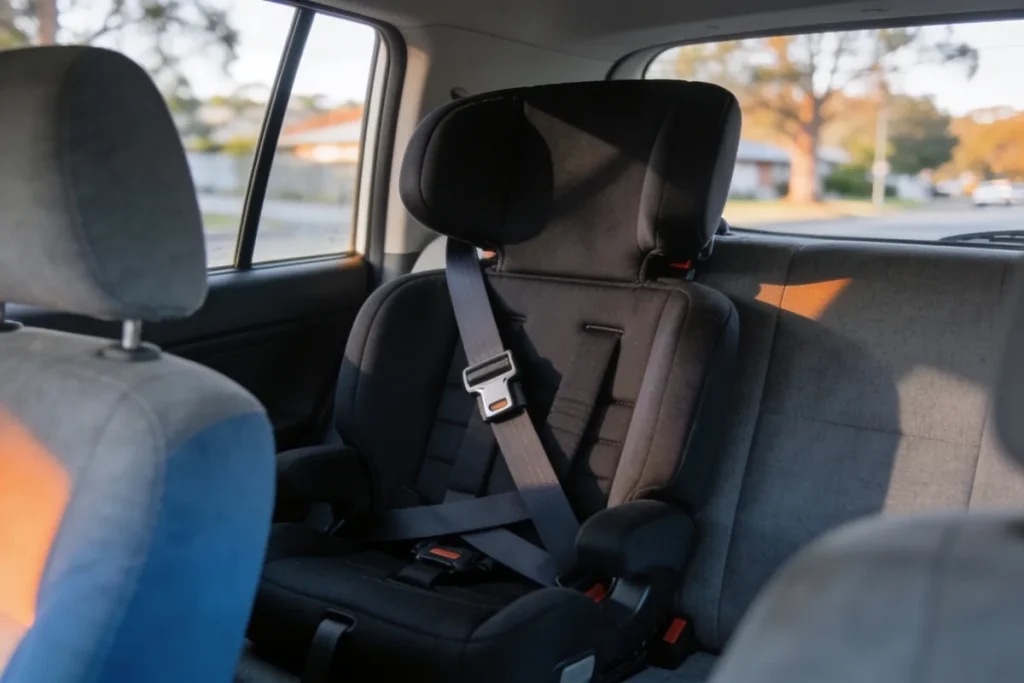
If the sash sits on the neck, the answer for now is not yet. That is a measurement. Your child has failed nothing, and you have done nothing wrong. The belt was built for a slightly bigger body, and with time it may fit.
I will not put a figure on how long that takes, because it depends on your child and on your car. A child may pass all five steps in one car and miss step three in another, and that happens often enough to be unremarkable. If you drive two cars, test in both. The test in the car you drive is the one that counts.
Where 145 cm comes from
You have probably seen 145 cm quoted as the height at which a child can use an adult belt. It is a useful number with a limited job, so it helps to see what the sources say about it.
Victoria’s Better Health page says an adult lap-sash belt “is designed for people who are a minimum height of 145 cm”. The ACT calls it a “suggested minimum height”. The 2020 NRA and Kidsafe guidelines, quoted in the Victorian coronial finding, call 145 to 150 cm a simple guide. None of these sources treats 145 cm as law, and the NTC says that age or height alone is “problematic” as a test, because rear seats and belts differ from car to car.
Use 145 cm as a quick guide to when the five-step test is worth doing. A child can reach it and still miss step three in a particular car, and a child a little under it may pass. The test settles it.
When the seat runs out before the child fits
Two limits are worth watching, and one of them belongs to the seat. The Queensland Government says to keep a child in the booster until their shoulders have passed the top marker. Once the marker is reached, the seat has done its job and the question becomes whether the child passes the five steps.
Sometimes the marker has been passed and the test still fails. That happens, and the answer is practical. A child in that position needs a bigger seat. Boosters now exist that go to about 10 (NTC), so it is worth checking what is available for larger children before assuming the next stop is the bare seatbelt. If you are unsure, the Transport Accident Commission page points to child restraint fitting stations, where someone can look at your child and your car together.
Some parents say that tall children outgrow their seats sooner than the range of larger boosters seems to allow for. It is a fair complaint, and it makes the fitting-station route more useful.
What may change
At the time of writing, nothing has changed in the law. The NTC has opened a review. Its issues paper, published on 27 October 2025, started a consultation that ran until 19 December 2025. A second round is planned, and transport ministers are expected to consider the work in late 2026.
The options on the table include raising the age at which a child may use an adult seatbelt to 8 or to 10, or defining “good seatbelt fit” in the rules by the five-step test itself. The paper also asks about the age at which children should sit in the front seat. If you read an article announcing a “new rule”, it is wrong, because the review has not finished. Check your own state’s page for the current wording.
In April 2026, a Victorian coroner’s finding said that a child travelling in an adult seatbelt alone should have been seated in an appropriate booster seat, and asked for a review of similar cases. It is part of why the question has had more attention lately, and it points to the same advice every official page gives: stay in the booster until the belt fits.
A law that sets a floor and leaves the judgement to the household is a familiar arrangement. The under-16 social media ban is another, where the rule marks a minimum and families still decide how to manage what sits above it. For booster seats, the household judgement now has a fair test to rest on.
The other side has a fair point. A child who passes all five steps in your car may leave the booster lawfully and sensibly. A child who has outgrown the seat’s marker belongs in a bigger seat, or out of it once the belt fits. The goal is a belt that sits where it should.
When your child wants out
This is likely the hard part, because the request is reasonable from where they sit. They are watching friends move on, and a booster can feel like a baby thing at seven or eight. A few small permissions can help.
You can tell them the seat is a belt-fit tool and the belt is what decides. You can let them do the five-step check with you, so the answer comes from the test rather than from you. And you can tell them what happens when they pass: the booster goes, because the test said so.
It is okay if this takes a few rounds of the conversation. It is okay if the answer is “not yet” again next term.
Until the seatbelt fits
Seven is the earliest the law lets a child out of a booster in nearly every state, which makes it a floor and leaves the leaving to fit. Keep your child in until they have outgrown the booster, meaning their shoulders are past the top marker, or until they pass the five-step test in the car you drive. For most children, that is 10 to 12.
Leave the birthday out of it as a deadline. Check the belt, check the car, and when it fits, it fits.
Sources: Child car seats, Transport for NSW (https://www.transport.nsw.gov.au/roadsafety/parents/child-car-seats); Rules for child restraints, Transport Accident Commission Victoria (https://www.tac.vic.gov.au/road-safety/road-users/parents/child-restraints); Child safety in the car, Better Health Channel Victoria (https://www.betterhealth.vic.gov.au/health/healthyliving/child-safety-in-the-car); Child restraint laws in Queensland, Queensland Government (https://streetsmarts.initiatives.qld.gov.au/?p=9986); Seatbelts and child restraints, SA.GOV.AU (https://www.sa.gov.au/topics/driving-and-transport/roads-and-traffic/seatbelts-and-child-restraints); Seatbelts and Parents, Road Safety Commission Western Australia (https://www.wa.gov.au/organisation/road-safety-commission/seatbelts and https://www.wa.gov.au/organisation/road-safety-commission/parents); Car Seat Safety, Department of State Growth Tasmania, December 2019 (https://transport.tas.gov.au/?a=112582); Seatbelts, Access Canberra (https://www.cityservices.act.gov.au/roads-and-paths/road-safety/seatbelts); Child car seats, Northern Territory Government (https://nt.gov.au/emergency/child-safety/child-car-seats); Review of child restraint requirements in the Australian Road Rules: issues paper, National Transport Commission, 27 October 2025 (https://www.ntc.gov.au/sites/default/files/assets/files/NTC%20Review%20of%20child%20restraint%20requirements%20in%20the%20Australian%20Road%20Rules%20-%20Issues%20paper_1.pdf); Improving child restraint rules, National Transport Commission (https://www.ntc.gov.au/project/improving-child-restraint-rules); Finding into death without inquest, Coroners Court of Victoria, 20 April 2026 (https://coronerscourt.vic.gov.au/sites/default/files/COR%202024%20000090%20Form%2038%20-%20Finding%20into%20Death%20without%20Inquest_Signed.pdf)