Style & Beauty
How Long Does Fake Tan Last? Why Yours Can Fade in Two Days
How long a fake tan lasts comes down to your skin and your aftercare, not the bottle. Why two-day fades happen, how to make it last, and how to remove it.

The wrists before the wedding
At six in the evening the tan looked the way it was supposed to look. By the speeches it has told on you: the wrists have gone patchy where they bend, there is a faint tide line at each ankle, and you are standing for the photographs with your arms folded, which you will later describe to yourself as a choice.
None of it was bad luck, and the tan did not fail: everything the bottle promised happened exactly as written. What nobody writes down is the part you are learning at a wedding, which is that the answer to “how long does fake tan last” is not a number, and was never going to be.
What self-tan actually is, and why that decides everything
The colour you got is not paint sitting on your skin. The active ingredient is colourless; what it does is react with the top layer of your skin, and the brown you see afterwards is, essentially, your own dead skin cells, stained.
Because the colour lives in that top layer, it lasts exactly as long as the layer does. Skin sheds constantly, faster in some places than others, and the colour leaves with it. Which means the question “how long does fake tan last” is really the question “how fast does your skin turn over”, and that is personal. It changes with your body, your age, the season, your shower temperature and everything you put on your skin afterwards. No bottle can answer a question about your skin. It can only describe the person who tested it.
Why every range you read says something different
Look at the published answers sometime, all in one sitting. One skincare site says a spray tan can last ten days to two weeks. A tanning brand says three to seven days on average. Another says four to six for most users. A summary floating at the top of search results says five to seven at home and seven to ten for spray. A salon page says five to ten.
Read together, they contradict each other, and the temptation is to call all of them wrong. That is not quite what is happening. They are different products measured by different people with different skin and wildly different aftercare, and most of the places publishing them are selling something. None of those ranges is a fix on you. Each is a description of somebody else.
The honest version is narrower and more useful: the only reliable prediction is a range for your own skin, built from your own last few tans. A reader who tracks two or three applications learns more than any article can tell them, this one included.
Why yours can last two days
When a tan vanishes in two days, one of the following is almost always behind it.
Going too hard with the exfoliant beforehand. Preparation matters, but there is a version of it that scrubs away the exact layer the tan is about to live in. Gentle, a day or two ahead, not the hour before.
Oil. In body wash, in moisturiser, in the cleanser used to take off makeup. Oil dissolves the colour, which is why remover products lean on it; it accounts for many two-day fades, and most people cannot tell you which of their bottles contain it.
The colour guide washing off in the first shower. Many products carry a temporary bronzer so the reader can see where they have applied it, and it rinses away in the first wash. It looks like the tan failing; it is not, and the real colour is still developing underneath. The false alarm fools people every time.
Hot water, shaving, swimming and chlorine. Each strips the top layer of skin faster than it would leave on its own, and a long hot shower plus an afternoon in a chlorinated pool is most of a tan gone.
And tight clothing on the first day, which rubs where a tan is trying to settle. Loose and soft until it has.
The moisturiser contradiction, resolved
Here is the confusion that draws the most replies in every comment section, and both things readers have heard are true.

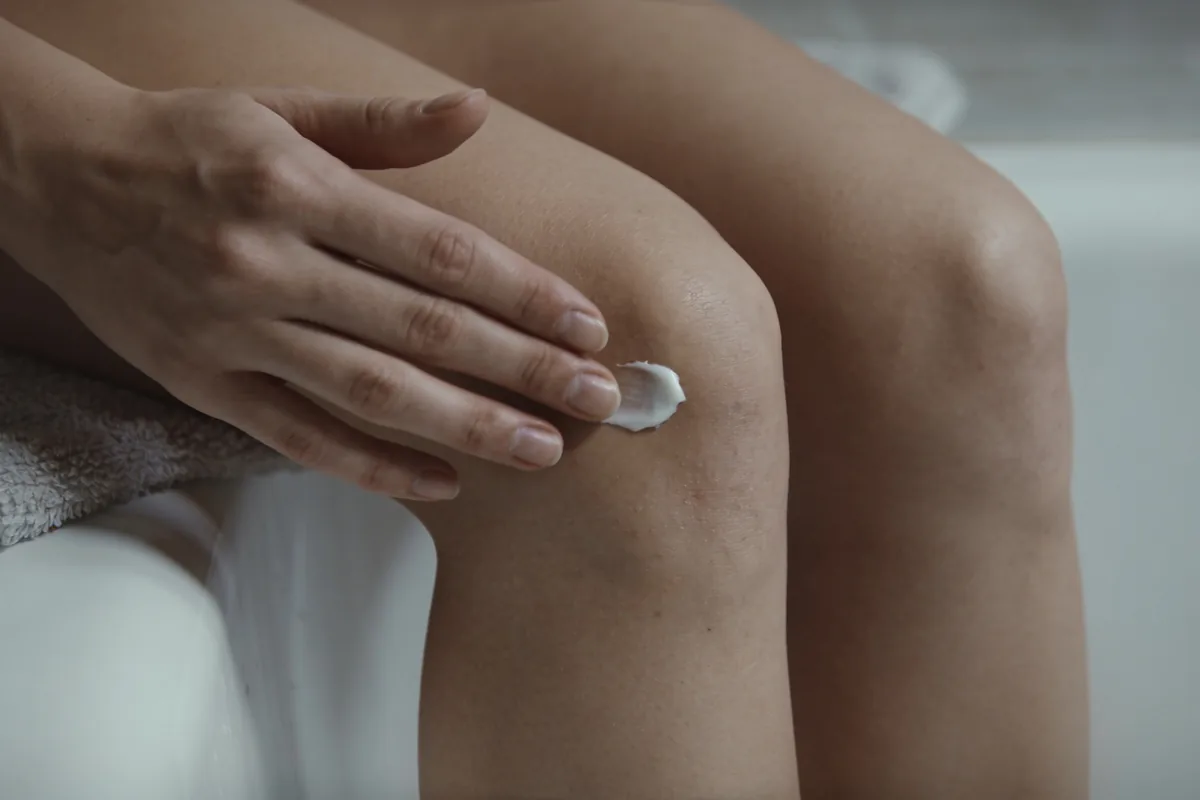
Yes: moisturise the dry areas before applying, meaning the knees, elbows, ankles, wrists and hands, because dry skin grabs more colour, which is how those spots end up darker and uneven.
No: do not put oil-based moisturiser on all over beforehand. Oil breaks the tan down and stops it developing evenly. The two pieces of advice are not in conflict: one is about a small amount of product on specific dry spots, before; the other is about the whole body, and it applies to oil at any time. Read them as one rule: moisturiser in the dry places, oil nowhere.
Getting it even
Two places let a tan down more than anywhere else.
Hands and feet. They bend, they crease, they take colour unevenly, and the first attempt usually makes them worse by trying harder. Do them last, with what is left on the mitt rather than fresh product, and wipe the palms, knuckles and nails afterwards. If the feet are their own recurring project, that is a skin question rather than a tan question, and the site’s guide to when a professional treatment is worth it and when it is not covers it properly: treat the skin first, and the colour behaves.
Chest and shoulders. The area readers say never goes as dark. The reason is mechanical: the skin there bends and stretches all day, the product moves with it, and the first coat goes on thinner because of the angle. The fix is not more product the first time; it is a second light coat, once the first has developed.
The technique readers swear by holds up: two light coats, a day apart, outlast one heavy coat and go far less patchy. Less product applied twice beats more applied once.
Making it last, honestly
What genuinely buys days is unglamorous: pat dry after showers rather than rubbing, use a gentle body wash, retire the loofah while the tan is on, moisturise daily with something oil-free, and rinse chlorine off the moment you are out of the water. None of it is dramatic; it is the difference between a tan leaving on its own schedule and one evicted early.
Two things cost days: a long hot shower, and chlorine, and if a pool day is coming, time the tan around it.
And the honest version of the famous “up to two weeks”: that belongs to a professionally applied tan with ideal aftercare, on skin that cooperates. It is a ceiling some people reach, not the typical result, and no product should be judged against a number most of its own customers will never see.
Removing it without wrecking your skin
This part stays short on purpose.
Time, gentle exfoliation, an oil-based cleanser worked in before a shower, and patience will remove a tan. That is the whole method. What will not help, and what can actively hurt: scrubbing hard, reaching for a harsh exfoliant every day, and the kitchen-cabinet remedies that circulate in forums, meaning bleach, lemon and anything else that was not made for skin. The tan sits in the top layer; beneath it is the skin that is the barrier, and damaging it to speed the colour along is a bad trade.
The useful turn, though: if the tan has gone streaky and an event is close, the fix is more tan, not more scrubbing. A second light application evens up what is there and adds days, where an aggressive scrub leaves you raw, patchy and further from the look you wanted.
The safety line nobody draws
Two very different things get blurred under the phrase “is fake tan bad for you”, and pulling them apart is the most useful thing here.
Topical self-tan products, the kind this article is about, are applied to the skin. The guidance is straightforward: patch test if you know your skin reacts, do not apply to broken or irritated skin, keep the product away from the eyes and mouth, and do not inhale the mist from a spray. That is the honest extent of it, and this article makes no medical claims either way.
The other thing is not a cosmetic at all. Melanotan injections and nasal sprays are sold online as tanning products, and they are a different category entirely: prescription-only medicines in Australia, not approved as tanning agents, and there are no Melanotan II products on the Australian Register of Therapeutic Goods. The Therapeutic Goods Administration has tested seized nasal sprays and found the doses inside wildly inconsistent from one bottle to the next. It has issued infringement notices totalling five figures against unlawful supply, and it reports serious side effects, including kidney failure, muscle breakdown and priapism. It states plainly that there is no evidence these products protect against skin cancer, and its advice to anyone holding one is to stop using it and take it to a pharmacy for disposal. Where these products are sold with confident claims attached, the discipline is the same one the site applied to gut health powders, where the label promised more than the evidence supported: confidence is not evidence, and a checkout page is not a pharmacist.
And then the line that belongs in every piece about tanning: a fake tan is not sun protection. The colour is cosmetic and gives no meaningful protection from UV; the safety a base seems to offer is an illusion. Sun protection remains hats, shade, clothing, sunscreen and reapplication, and Cancer Council is the authority worth reading on that and on tanning more broadly.
One cultural note, kept short: a lot of the pressure to tan is social rather than personal, and readers say so themselves. The tan is a choice, and this article is not going to argue anyone out of it, or pretend the pressure is not there. The practical advice above works the same either way.
The honest version, including what to skip
Skip the multi-step kits if this is a first attempt; one well-applied product teaches you more than a shelf of bottles. Skip the express formula if your tan already goes patchy, because fast development is even less forgiving of uneven skin. Skip the second coat if the first one is right; the layering advice here is a fix for a problem, not a rule to follow off a cliff. And skip the whole exercise if you are happy as you are. That is a legitimate outcome, and nothing in this article is an argument against it.
What the number leaves out
Every range you have read leaves out the only variable that matters to you, which is you: your skin, your aftercare, your week. The number was never on the bottle, and the sooner a reader stops shopping for the one promising the longest, the sooner tans start behaving. Get the preparation and the aftercare right, learn your own range from your own last few, and plan the second light coat before the event rather than the rescue after it. The wedding photographs will take care of themselves.
Sources: Therapeutic Goods Administration – Melanotan II tanning products safety alert · Cancer Council Australia – tanning, solariums and skin cancer · Australian Competition and Consumer Commission – health and beauty claims