Food
Is an Air Fryer Cheaper to Run Than an Oven? Count Your Batches
An air fryer is a small fan oven, so whether it saves you money depends on four things. Here is when it wins on running costs, and when the oven still does.

Say the thing
An air fryer is a small fan oven with a better seal and a shorter distance to heat. That is the machine. There is no magic in it, and anyone selling you the magic is selling you the machine with better lighting.
Which is why the running-cost question has a real answer, and the answer is conditional. An air fryer is cheaper to run for some cooking and more expensive for other cooking, and the variable that decides which is not the brand. It is the size of the portion.
The mix-up usually starts with the comparison people run in their heads: one appliance’s best case against the other’s worst, a single portion in the air fryer against a full Sunday roast in the oven. Run the same meal through both honestly and the numbers change sides depending on one variable. So the honest answer is not “cheaper” or “more expensive”. It is “cheaper per meal you actually cook in it”, which is a sentence with a variable in it, and the variable is yours to measure.
Why size decides everything
An oven is a large cavity. When it heats up, most of the energy goes into warming a space you are not using, and the preheat alone can run ten to fifteen minutes before any food starts cooking. A small cavity reaches temperature faster, holds it with less waste, and puts the heat closer to the food. On that comparison, the air fryer wins, and it wins clearly.

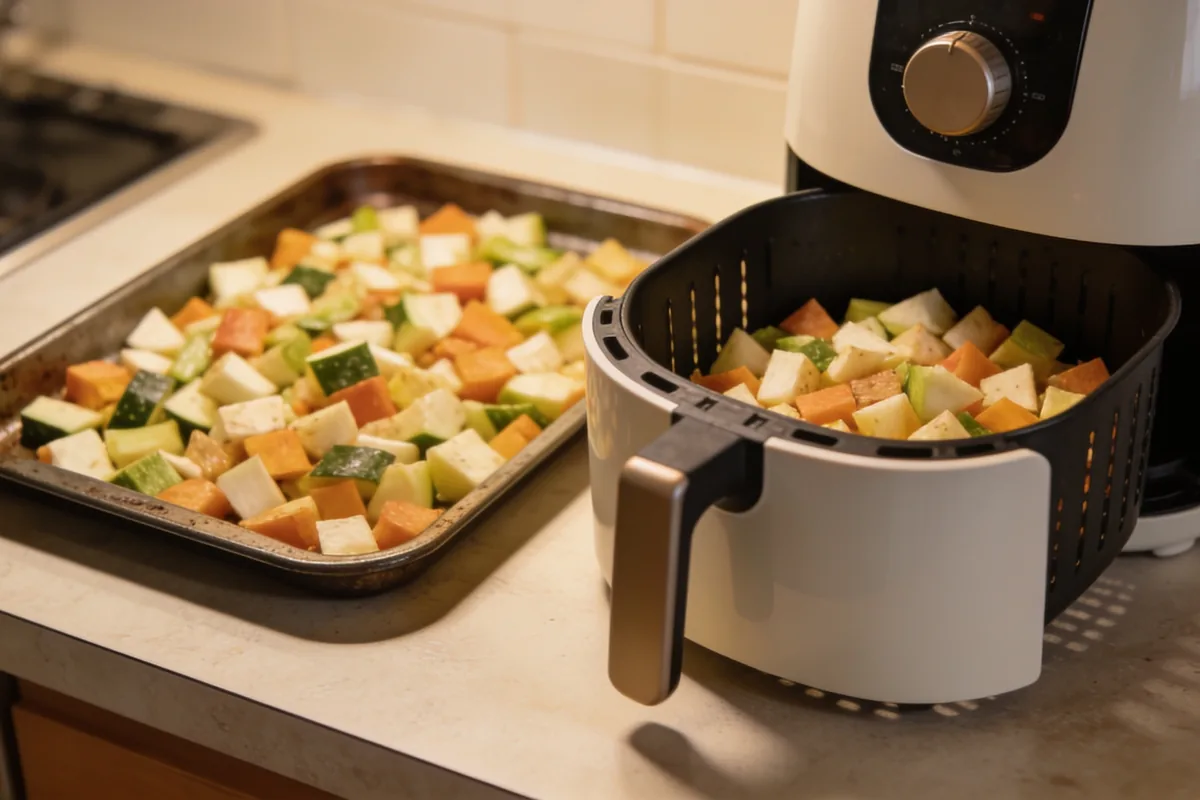
Then the basket gets in the way. The capacity is fixed, and it is smaller than most people expect the first time they see it. Cooking for one or two fits in a single batch, and the saving holds. Cooking for four means two batches, maybe three, and every extra batch is another round of heating a cold machine back to temperature. By the third run you are not saving anything, because you have effectively cooked three times. This is the part the enthusiastic reviews skip, and it is the entire answer to the question in the title.
Two details sharpen the mechanism. The first is what an oven actually spends its energy on: a large box of steel, air and door glass, all of it warmed to temperature before the food sees any heat, and then held there by an element cycling on and off to replace whatever escapes through the seal and the vents. The air fryer runs the same cycle in miniature, with a smaller box, a tighter seal and far less air to keep warm, which is why it can reach cooking temperature in the time the oven spends just getting started.
The second detail is the batch problem, stated as the rule it deserves to be. One batch, the air fryer wins comfortably. Two batches, it is close. Three, and the oven that heated once has beaten the machine that heated three times, because every cold restart repeats the most expensive part of the process. Count the batches before counting the savings, and the question answers itself.
The four things that decide it
Four variables set the real cost, and three of them are specific to your kitchen rather than to the appliance.
The first is portion size. Does the meal fit in one batch? That single question decides more than any spec sheet.
The second is preheat and cook time. An oven’s preheat is usually the largest single cost of a meal, and the air fryer’s shorter warm-up is where its advantage lives. Any dish where you would run the air fryer three times erases that advantage.
The third is the appliance’s power draw, measured in watts, which is printed on the label. A small appliance running briefly can use less than a large one running long, but that only holds when the portions actually fit.
The fourth is your electricity rate, which is not printed on any appliance in the country. Tariffs differ by state, by distributor and by plan, and that variability is why nobody, including this article, can give you one honest number for what an air fryer costs to run.
One reassurance about all four: you do not need exact values for any of them, because the decision does not hinge on decimals. It hinges on whether the portions fit and how many times the machine runs. A rough wattage from the label, a rough count of minutes, and the rate already printed on your last bill will separate the two appliances clearly enough. Precision matters less than honesty about the batch count, and the batch count is the one variable people shade without meaning to.
One honest complication on the rate itself: some plans charge different amounts at different times of day, so the same meal can cost differently at six and at eight in the evening. Check whether that applies to your plan before comparing notes across households, because two identical kitchens on different tariffs are not having the same argument.
How to work out your own
The method takes three steps and about five minutes, and the figure it produces is true for your house, which is worth more than any national average.
Find the wattage. It is on the label on the appliance, or in the manual, expressed in watts.
Estimate the hours. Not the rated hours, the actual ones: how long you would run the air fryer for that meal, including its warm-up, and how long the oven would take for the same meal, including its longer preheat.
Multiply. Wattage, converted to kilowatts, times the hours, times the rate on your own bill. The result is the cost for that meal in your kitchen, and repeating it for the meals you actually cook is a better answer than anyone else’s number could be.
Two notes to keep the estimate honest. The wattage on the label is the maximum draw, so treat the result as a ceiling rather than a prediction; a machine that cycles to hold its temperature uses less than its label suggests. And estimate rather than agonise. The point is not to produce an audit-ready figure. It is to replace a vague assumption with a real one, and even a rough number from your own kitchen beats the confident percentages floating around online.
When the oven still wins
The oven is not the villain of this piece, and the honest version of the comparison has to say so.
A full tray of roast vegetables fills the cavity and uses the space that the air fryer would waste. A family-sized bake, a casserole, a large piece of meat: these are oven jobs, and no amount of efficiency in a small basket compensates for capacity it does not have. Anything that would need three batches is an oven meal, and the arithmetic is not close. There is also a cost the electricity bill never shows, which is your evening: an extra batch is another twenty minutes of your life spent beside a humming machine, and that is a real price even when the meter disagrees. When the oven wins, it usually wins because there are people coming, which is the same distinction the site draws in its piece on cooking for a table rather than for one.
The oven also asks less of your attention across the whole exercise. Tray in, timer set, walk away, and enough room that nothing needs a second round. Those are real advantages, and they rarely appear in the running-cost debates because they do not show up on a bill. The bill is not the only ledger. Time and attention sit on one too, and the oven wins some lines on both.
Which way that balance falls is worth deciding before the appliance is bought rather than after. A household that mostly plates two dinners and occasionally feeds eight is an air fryer household with an oven for the occasions. A household where eight is the normal Tuesday is an oven household that might enjoy a basket for the sides, and should buy it with that modest job description in mind. The machine is the same in both kitchens. The question it answers is not.
The downside nobody mentions
The sceptical questions about air fryers are fair, so here is the honest list. Bench space, first and always. A fixed basket that cannot be talked into holding more. Another machine to clean, another machine to store, and a drawer that never quite fits where you want it. And the fundamental one: if you rarely cook for one or two, it will not earn its place, no matter how efficient it is at a job you are not asking it to do.
And the noise, while we are being complete. A machine that needs a conversation paused does not get used as often as one that hums along unnoticed, and an underused appliance is the most expensive purchase in the kitchen per meal cooked. Frequency of use is the quietest variable in the whole calculation, and one of the decisive ones.
So, should you keep it?
If you cook for one or two, most days, and the meals you make fit the basket in a single go, it earns its bench space and its running cost beats the oven’s for those meals. If you cook for four or more, or the machine lives on a shelf behind a cupboard door, it probably will not. The appliance is not the problem either way. The mismatch is. And if all of this has your mind on what goes in the basket rather than what heats it, that is the more important half of the question anyway: the site’s piece on the foods that actually fuel a day is the place for that argument.
One good use for a machine that ends up on the bench: the nights when the oven is busy with something else. A bake in the oven and a tray of sides in the basket, running side by side, is a better argument for keeping it than any efficiency figure, and it is the one capacity question the basket answers without complaint.
When the air fryer earns its bench
Efficiency was never the deciding question. Fit was. A small oven that matches how you actually cook is a good appliance; a small oven stretched over a family meal is an expensive one. Work out your own number, count your batches honestly, and the machine will tell you where it belongs: in the cupboard, on the bench, or on a marketplace listing by Sunday.
Sources: Australian Energy Regulator – how electricity tariffs and usage are charged · Energy.gov.au – appliance energy ratings and running costs · CHOICE – small kitchen appliance testing