Healthcare
Before the Kids and the Dog Go In, the Blue-Green Algae Alert Says More Than Clear Water Does
Clear water proves little. NSW and Victoria rate blue-green algae green, amber or red; Queensland uses four toxin levels. Read the alert before the kids go in.

The question “is this water safe today?” is two questions. The first asks what the water looks like. The second asks what has been recorded about it. Only the second is a measurement, and only the second is a sound basis for a decision about children and a dog.
The position of this article is therefore straightforward. Check the alert for that particular waterbody before going, and treat clear water as no evidence in either direction. A red, high or extreme alert means staying out of the water and keeping dogs and livestock away from it. An amber or medium alert means the water is open but not all-clear, and the decision then belongs to the household. A precaution that this article adds for amber, and labels as its own rather than the regulator’s, appears in the section on children and dogs.
Two boundaries apply. This article covers freshwater lakes, dams, rivers and weir pools. Coastal water follows different advice and falls outside it. And none of this constitutes medical advice; it is a reading guide for the public information that state authorities publish.
Many Australian outdoor hazards share one feature, which is that a single fact decides the correct response. Our guide to telling a funnel-web bite from a redback bite shows the pattern for spiders. For blue-green algae, the deciding fact is the current alert level for the waterbody in question.
Why the eye fails
Blue-green algae are cyanobacteria, and the colour of the water gives a poor account of whether they are present in harmful numbers. The Victorian Government’s waterways page (updated 22 July 2026) states that harmful algae “are not always visible or detectable by smell”. It adds that “even when water appears clear, some harmful species may be present and cannot be seen without testing”. The cells are normally too small to see individually. A bloom becomes visible only when they gather in quantity.

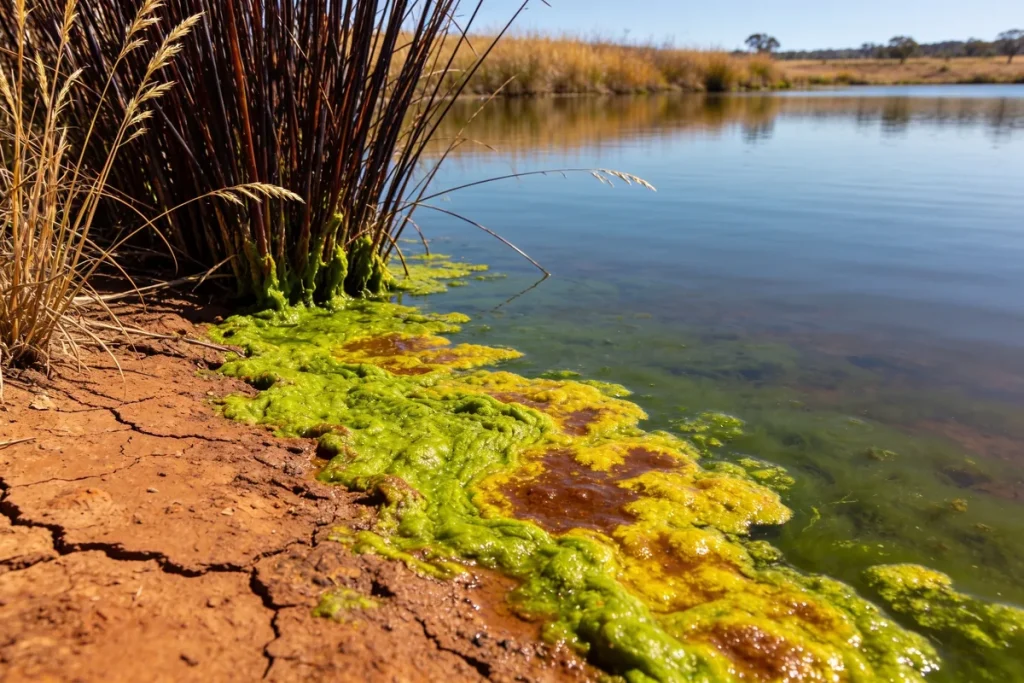
When they do gather, the Victorian page describes scums that range from dark green to yellowish-brown and look like paint when they dry at the water’s edge. That description is useful in one direction. Visible scum or discolouration is a reason to leave the water alone. Its absence says very little, because a waterbody can carry harmful species without showing either.
The conditions that favour a bloom are better understood than its appearance. The Victorian page lists nutrients, low inflows and warmer weather, and WaterNSW describes still or slow-flowing water. Those conditions together explain why still dams, weir pools and sheltered lake edges deserve more caution than a fast, shallow creek in cool weather.
A common view in public discussion is that water which is clean, flowing and without a smell can be trusted, and that locals know their own water better than any map does. Both points have something in them. Flow is one of the conditions that discourages a bloom, so a running creek is generally a lower risk than a standing dam, and a person who visits the same swimming hole every week will notice changes that a map cannot. The difficulty lies in the other two parts of the rule of thumb. The official guidance says smell is unreliable, and clear water can still carry harmful species. Local knowledge is a good companion to the alert and a poor substitute for it.
What an alert is
An alert is a result, and a result has a date. It records what a sampling visit or an inspection found at one place on one day, and it stays on the map until the next result replaces it.
The sampling schedule explains the gap. The National Health and Medical Research Council’s guidelines for recreational water (2008, Table 6.6) set out a monitoring frequency that rises with the alert level: weekly or fortnightly while a waterbody is at green, and twice weekly at amber where known toxin-producing species dominate, or weekly or fortnightly where other types do. Between visits, no new measurement is made. The NSW alert definitions state that conditions can change quickly, and that amber water can reach red in warm, calm weather.
The map has its own limits. WaterNSW’s Algae Alerts page states that algal blooms “may be present and not reported”, and the map excludes storages that have no public access. A waterbody that does not appear has simply not been reported on. It has not been cleared.
Not every alert comes from a laboratory, either. WaterNSW’s red alert for Lake Yarrunga, issued on 25 June 2026 as a precaution, was “based on visual observation”. That is a reasonable basis for caution, and it shows that an alert can rest on an inspection as well as on a cell count.
In practice the reader should look for two things on any alert: the level, and the date it was set. A green alert from last week describes last week. It is still the best available guide, and it should be read with the weather of the past few days in mind.
Take a hypothetical weir pool whose alert reads green, set nine days ago. Under the NHMRC schedule that is an ordinary interval, because sampling at green runs weekly or fortnightly. If the days since have been hot and windless, the sensible reading is that the water was fine when sampled and may have moved since, so the signs at the site and the look of the edge carry more weight than usual. If the days since have been cool and breezy, the same alert deserves more confidence. The alert is identical in both cases and the right level of trust is not, which is why the date and the weather belong beside the colour.
The scales side by side
New South Wales uses the three-colour scale from the NHMRC 2008 guidelines, based on cell counts or biovolume, and Victoria’s scale uses the same colours with closely matching bands. Queensland’s Seqwater uses four levels and sets them by toxin concentration. The practical conclusion lines up across all three, since red, high and extreme each mean no swimming, but the words and the units differ. The table sets them next to one another.
| Authority | Levels | Measured by | What the top level means |
|---|---|---|---|
| NSW (alerts published through WaterNSW, using NHMRC 2008 definitions) | Green, Amber, Red | NHMRC cell counts or biovolume | Red: bloom conditions. Avoid contact, keep dogs away, and do not fish where scum is present. Amber: described as “generally suitable for water sports” with caution; can reach red quickly in warm, calm weather; may be unsuitable for stock watering |
| Victoria (Victorian recreational scale, as applied by Lower Murray Water) | Low (green), Medium (amber), High (red) | Biovolume in mm³/L | Red: warning signs placed in popular recreation areas |
| Queensland (Seqwater recreation lakes) | Low, Medium, High, Extreme | Toxin concentration | High: closed to in-water recreation such as swimming, skiing and tubing, with on-water activity still open. Extreme: closed to in-water recreation, with an advisory against on-water activity. Medium: open, with testing moved to fortnightly. A lake at High reopens after two consecutive acceptable results |
For the two three-colour scales, the biovolume bands can be placed side by side as well. The NHMRC figures come from Table 6.2 of the 2008 guidelines, and the Victorian figures from Lower Murray Water’s table.
| Level | NHMRC 2008, Table 6.2 | Victoria, as applied by Lower Murray Water |
|---|---|---|
| Green / Low | 0.04 to under 0.4 mm³/L | 0.04 to under 0.4 mm³/L |
| Amber / Medium | 0.4 to under 4 mm³/L where a known toxin producer dominates; 0.4 to under 10 mm³/L where known toxin producers are not present | 0.4 to 10 mm³/L; 0.4 to 4 mm³/L where toxic species dominate |
| Red / High | 4 mm³/L where a toxin producer dominates; 10 mm³/L where known toxin producers are not present; or scums consistently present | 10 mm³/L and over; over 4 mm³/L where toxic species dominate |
Two points follow from the tables. The first is that the Victorian and NHMRC bands agree closely, so a reader who knows one scale already knows the other. The second is that Queensland’s toxin-based levels cannot be converted into either of them, because they measure a different thing. Seqwater’s High is a statement about toxin in the water, whereas an NSW or Victorian Red is a statement about how much algae is present. The reader should apply each authority’s words to that authority’s waterbodies and not carry a level across state lines.
One further limit belongs here. The NHMRC guidelines are national guidance and not a law, and the guidelines themselves are scheduled for review. The states apply them, and each state may phrase its advice differently.
Where to look
The alert for a waterbody lives with whoever manages it, which varies by state.
New South Wales. The WaterNSW Algae Alerts map covers the storages it manages. WaterInsights offers free email or SMS alerts for those who want a notification in place of a daily check. The Wentworth Shire Council page prints an algae hotline number, 1800 999 457, and that number is quoted here only on that attribution.
Victoria. Start with the local water corporation or council. For the Murray, Lower Murray Water publishes a map, and the Victorian Government waterways page sets out the state framework.
Queensland. Seqwater publishes a “Blue-green algae levels” page for its lakes, and Seqwater signs appear at lake entry points only where a closure or advisory applies.
South Australia. SA Health maintains a “Water quality alerts” page, which was last updated on 20 August 2026.
Western Australia. The Department of Health issues warnings through local government and on-site signs, and HealthyWA explains what they mean.
Whichever page is used, three details are worth reading before the level itself: which agency publishes it, which waterbody it names, and the date of the most recent result. A page for a reservoir upstream says little about a dam downstream, and an alert for one arm of a lake may not describe the arm where the family intends to swim.
Tasmania, the Northern Territory and the Australian Capital Territory are not covered here, and other authorities exist in every state. In those places, and wherever a sign is posted at the water, follow the signs. A sign at the site is the most current instruction available to a visitor standing there.
Kids and the dog
The official advice at red is consistent. WaterNSW’s alert of 25 June 2026 asks people to avoid recreational contact with the water until the alert is lifted, and to prevent pets and livestock from drinking it. The NSW alert definitions, as published by Wentworth Shire Council and endorsed by the NSW Algal Advisory Group, add that owners should keep dogs away from areas at a high alert level.
Children warrant particular care. Seqwater’s recreation procedure summary notes that children have a lower body weight and are more likely to swallow water, which is why a level that an adult might accept can call for more caution when the swimmers are small. Water skills are a separate protection altogether, and our guide to swimming lessons by age covers the first steps in building them.
Two further points come from the agencies. Mussels and crayfish taken from red areas should not be eaten, and boiling water does not remove the toxins (WaterNSW; Queensland Health). Anyone who suspects they have been affected should seek medical advice (WaterNSW). This article does not go further than that, because the symptoms and the treatment belong to a vet and a doctor. Vet costs also belong in any household’s dog budget, and our look at the first-year cost of a dog sets out what a household can expect to spend.
Our own precaution at amber. The official keep-animals-away advice sits at red. Amber is a decision for the household, and this precaution is ours, offered as such: at amber, stop the dog from drinking or licking the water, and leave any water with visible scum or discolouration alone, whatever level the alert shows. If a dog has been in, or has drunk from, water at red, we would also ring a vet. The precaution costs little, and the NSW definitions note that amber water can reach red quickly in warm, calm weather.
Before you go: five checks
- Look up the alert for that waterbody on the state or local authority’s page, and note the date it was set.
- Read the signs at the site, which override anything seen online.
- Look along the edge for scum, discolouration or a paint-like film, particularly where the wind has pushed material into a corner.
- If the alert is red, high or extreme, choose another place for the day, and keep the dog and any livestock away from it.
- If the position is uncertain, wait for the next result. Waiting costs little, and entering on a guess may cost more.
Check first, then decide
The reading is simple once the two questions are separated. What the water looks like is a weak guide, and what has been recorded about it is a stronger one. Look up the alert, note the date, read the signs, and treat red, high and extreme as a reason to choose another place. Treat amber as a decision for the household, made with the dog kept from drinking and any scum left alone.
The fair point on the other side is that fast creeks carry less risk than still dams, and that people who know their local water often notice a change before the map does. Both belong in the decision, alongside the alert and never in place of it. The one habit to leave behind is judging the water by its colour.
Sources: Guidelines for Managing Risks in Recreational Water, National Health and Medical Research Council, 2008 (https://nhmrc.gov.au/sites/default/files/images/guidelines-for-managing-risks-in-recreational-water.pdf); Algae Alerts NSW map, WaterNSW (https://www.waternsw.com.au/water-services/water-quality/algae-alerts); Precautionary blue-green algae Red Alert for Lake Yarrunga, WaterNSW, 25 June 2026 (https://www.waternsw.com.au/news/media-releases/2026/precautionary-blue-green-algae-red-alert-for-lake-yarrunga); Blue-green algae, Wentworth Shire Council, alert definitions for recreational waters (https://www.wentworth.nsw.gov.au/blue-green-algae-updates); Harmful algal blooms, Victorian Government, updated 22 July 2026 (https://www.water.vic.gov.au/waterways/blue-green-algae); Blue-green algae, Lower Murray Water (https://www.lmw.vic.gov.au/water-supply-and-services/water-quality-and-treatment/blue-green-algae/); Blue-green algae levels, Seqwater (https://www.seqwater.com.au/blue-green-algae-levels); Blue-green Algae Recreation Management Procedure summary, Seqwater (https://seqwater.com.au/document/870); Blue-green algae in freshwater, Queensland Government (https://www.qld.gov.au/environment/water/quality/algae/health); Water quality alerts, SA Health, updated 20 August 2026 (https://www.sahealth.sa.gov.au/wps/wcm/connect/public+content/sa+health+internet/public+health/water+quality/water+quality+alerts); Algal blooms, HealthyWA (https://healthywa.wa.gov.au/Articles/A_E/Algal-blooms)