Eco Friendly
Rinse, Reuse, Recycle: The Great Green Debate Down Under

Introduction
It’s 2025, and Aussies are still bickering over the big stuff — rinse the reusable cup or toss it and feel smug about recycling?
At the heart of it lies one simple question: Is it better to reuse or recycle?
Both sound good. Both feel good. But which one’s actually doing the heavy lifting? Here in Australia — where plastic bags were banned, unbanned, then rebanned — it matters more than ever. We churn through billions of plastic items each year, many of which end up in landfills, oceans, or even floating across Bondi.
Understanding the Basics
| Aspect | Reusable Items | Recyclable Items |
| What are they? | Made to be used many times (e.g., stainless steel bottles, cloth bags, keep cups) | Designed to be processed into new items (e.g., aluminium cans, plastic bottles, cardboard) |
| How do they help? | Reduce waste by avoiding single-use items | Reduce waste by turning old items into new products |
| Use & Care | Need to be cleaned and used often to be effective | Must be clean, dry, and sorted properly for recycling |
| Common issue | Sometimes forgotten or not cleaned properly | Contamination (dirty or mixed materials) can send them to landfill instead |
| Environmental impact | Higher energy to make but much better the more you use them | Less energy to make but recycling depends on proper sorting and processing |
| Examples | Keep cups, stainless steel bottles, cloth bags | Aluminium cans, PET plastic bottles, cardboard boxes |
Environmental Impact Comparison
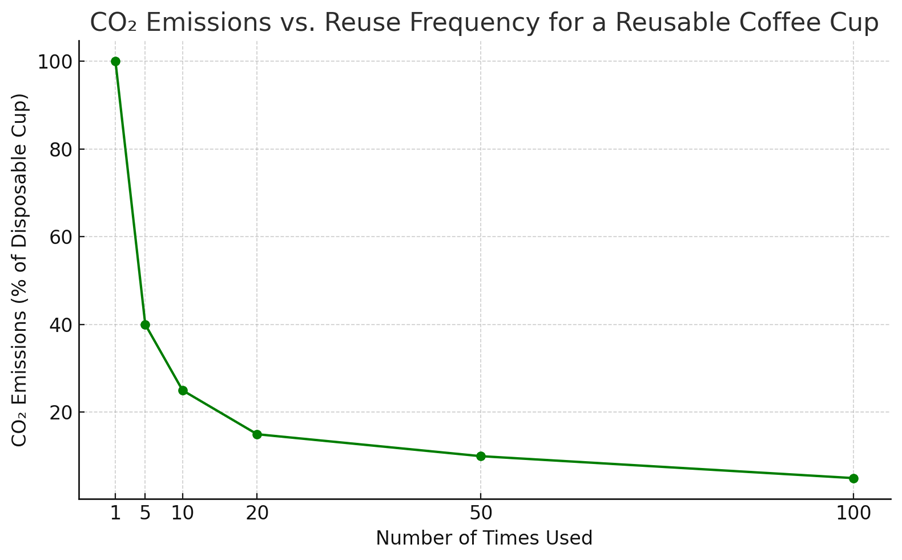
Here’s a simple chart showing CO₂ emissions versus reuse frequency for a reusable coffee cup.
As you can see, a reusable cup’s carbon footprint is high when brand new, but it drops significantly the more you use it.
By the time you reach about 20 uses, the emissions are just a fraction of what a single-use disposable cup produces.
This kind of visual can help your readers grasp why reusing really makes a difference over time.
Reusable items: benefits when used consistently
Reusable items shine when used consistently. A keep cup, for example, can replace hundreds of takeaway cups a year.
Containers, beeswax wraps, and lunch boxes are other daily winners.
They cut waste and save you money too.
Recyclable items: better when reuse isn’t practical
Recyclable still have their place. Not everything is easy to carry or wash — like fizzy drink cans or sauce bottles.
Aluminium cans, when recycled properly, save a whopping 95% of the energy needed to make a new one. They’re one of the most recycled items in Australia.
Challenges with Both
Reusing and recycling aren’t always easy.
Recycling can be tricky because if one thing is dirty, it can spoil the whole batch. Sometimes people put the wrong things in the recycling bin hoping it will get recycled — but that often causes problems.
Reusables are great, but we sometimes forget to use them. We might leave bags in the car or cups at home. And if we don’t clean them well, they can get mouldy or dirty.
Also, not every local council recycles the same things. Some don’t take soft plastics or coffee cup lids.
So, both reusing and recycling work better when we remember to do our part — like cleaning and sorting properly.
What the Experts and Stats Say
Australians make about 76 million tonnes of waste a year, but only 60% gets recycled — and soft plastics even less.
Lots of things marked “recyclable” don’t get recycled.
Experts say reusing stuff is even better than recycling. It can cut down waste by a lot — up to 90% over time. It’s all about good habits, systems, and making things last.
You don’t have to be perfect. Every little bit helps — a reused bottle or a recycled can adds up fast. So, take it easy and be smart with what you use.
The Final Verdict
So, what’s the bottom line?
Use reusables when it’s easy and practical — shopping, commuting, and café runs are perfect.
Go for recyclables when reuse isn’t realistic — like tinned food, soft drink cans or cardboard packaging. But make sure they’re clean and dry before tossing them in the bin.
The goal isn’t to be perfect. It’s to be better, one habit at a time.
Every reuse counts. Every clean recycling choice makes a difference.
So, here’s the gold nugget, straight from the Aussie handbook:
“Reuse when you can. Recycle when you must. Don’t be a Muppet either way.”
Let’s leave the world better than we found it — and yes, rinse the cup.


A Local’s Perspective on Choosing the Right Plumber in Altona

From Design to Durability: Choosing the Right Cabinet Hardware in Melbourne

A Closer Look at WordPress Web Hosting in Australia: Tools, Features, and Real Benefits

Eastern Eats: 6 Must-Try Restaurants in Melbourne’s Eastern Suburbs

Why Community Participation in Alice Springs Matters: Bridging Gaps, Enhancing Opportunities, and Building Stronger Communities

The Role of Speech Therapy in Treating Common Speech & Language Disorders
-
 Food10 months ago
Eastern Eats: 6 Must-Try Restaurants in Melbourne’s Eastern Suburbs
-
 Healthcare10 months ago
Why Community Participation in Alice Springs Matters: Bridging Gaps, Enhancing Opportunities, and Building Stronger Communities
-
 General10 months ago
The Role of Speech Therapy in Treating Common Speech & Language Disorders
-

 Healthcare10 months ago
Don’t Let Heel Pain Rule Your Life: Why Heel Pain Specialists in Sydney Are the Experts You Need
-

 Healthcare10 months ago
Supporting Your NDIS Journey in Sydney: Why Partnering with a Skilled Provider Can Make a Lasting Difference in Your Life
-

 General10 months ago
Polycarbonate Roofing Sheets: Why They Are the Go-To Option for Outdoor Structures, Greenhouses, and Patios
-

 Healthcare10 months ago
Managing Chronic Conditions with Ease: Understanding the EPC Plan
-

 Healthcare10 months ago
Partial Nail Avulsion (PNA): A Quick and Effective Solution for Ingrown Toenails