Travel
Six Months Left on Your Passport Is Already Late: Renewing in Australia
Passport renewal in Australia costs $422 for an adult and routine processing allows six weeks. Why six months of validity left can already be too late.

The expiry date and the date that counts
A month before a trip to Bali, most people run the same check: find the passport, open it at the photo page, read the expiry date and feel relieved that it falls sometime next year. The relief is premature. An expiry date records when the document stops being valid, and the country you are flying to applies a separate test, one set by its own government and measured against your travel dates rather than against the date printed in the passport.
Smartraveller, the Australian Government’s travel advice service, puts the position plainly on its Indonesia page: many countries require a passport to be valid for at least six months before entering or departing, and that includes transit. The same page adds a sentence worth reading twice, which is that the Australian Government does not make these rules. Each destination sets its own, which means the answer to “is my passport good enough?” depends on where you are going rather than on the passport.
Indonesia makes a useful worked case. For a visa on arrival, Smartraveller states that the passport needs at least six months of validity from the date you plan to enter, and it recommends six months from the date you depart as well. A passport with five months left on the morning of the flight therefore fails a test the traveller may not have known existed, even though the document is, by its own printed date, perfectly current.
The departure recommendation has a further effect that is easy to miss. The longer the stay, the later the six-month window ends, so a passport that clears the rule for a one-week holiday can fall short for a three-month stay on exactly the same document.
That is the trap in the title. Six months is the threshold itself, and a passport sitting right on it has no margin left at all.
Work it backwards
The arithmetic is short, and it runs in the opposite direction to the way people usually approach it. Start with the day you fly home, add six months, and compare that date with the expiry on your passport; if the expiry comes first, the passport fails the common version of the rule even though it is valid today.
Then subtract the time a renewal takes. The Australian Passport Office, part of the Department of Foreign Affairs and Trade (DFAT), allows up to six weeks for a routine application, so the realistic deadline for starting a renewal sits at least six weeks before departure, and earlier for anyone who would rather not depend on the far end of that window.
A worked example makes the shape clear. Suppose a family flies out to Bali on 6 March and home again on 20 March. Six months on from the return is 20 September, so any passport in the group expiring before 20 September needs replacing before the trip, and a routine renewal for a 6 March departure should be lodged by 23 January at the latest.
Two limits on that calculation deserve stating.
- Six months is a common rule rather than a universal one. Countries set their own periods and their own starting points, so the only reliable check is the Smartraveller page for each country on the itinerary, and that includes any country you only pass through.
- Six weeks is DFAT’s upper bound for routine processing, and DFAT does not promise any individual application will come in under it. The safe plan assumes the full six weeks.
A transit stop deserves its own line, because it is the part of the rule people skip. Smartraveller’s wording covers transit explicitly, so a connection through a third country brings that country’s rule into the calculation, even if you never leave the airport.
Renewal or a new application?
Not every passport can be renewed. DFAT treats renewal as a simpler path for adults whose existing passport meets a specific list of conditions, and if any one of them fails, the application becomes a new adult passport instead.
Under DFAT’s adult passport guidance, you can renew only if every one of the following is true of your current passport:
- It was issued when you were 16 or older.
- It was issued on or after 1 January 2006.
- It was valid for at least two years when it was issued.
- Your name, date of birth, place of birth and gender are the same as when it was issued.
- It is not lost, stolen or cancelled.
The list is short, and each condition removes a group of people from the renewal path. Someone who has changed their surname since the last passport fails the fourth. Someone whose most recent passport was issued at 15 fails the first. Anyone whose passport has gone missing fails the fifth. For each of them the route is a new adult application, and a new application needs a referee or guarantor, which a renewal does not.
Settling which path applies is the first task, because it decides the form you fill in and what you bring to the counter. Everything below assumes the renewal path; where a new application differs, DFAT’s adult passport page sets out the differences.
What it costs (fees from 1 January 2026)
DFAT publishes its fees on the Australian Passport Office fees page, which on 3 October 2026 still listed them as fees as of 1 January 2026. The figures below are taken from that page and apply from 1 January 2026.
| Service | Fee from 1 January 2026 (DFAT) |
|---|---|
| Adult passport, 10 years | $422 |
| Adult passport, 5 years (optional, aged 75 and over) | $213 |
| Child passport, 5 years | $213 |
| Fast Track processing, on top of the passport fee | +$107 |
| Priority processing, on top of the passport fee | +$308 |
Three points the table does not make on its own.
- Fast Track and Priority are added to the standard fee rather than replacing it. DFAT’s processing-times page lists each as the standard fee plus the extra amount.
- They buy speed. Who is allowed to buy it is a separate question, covered in the next section, and some applicants cannot use either service at any price.
- Australians renewing from overseas pay a surcharge on top of the application fee, which DFAT lists at $189 for an adult passport.
One row needs a word of its own. The five-year adult passport for applicants aged 75 and over is listed as optional, so it sits beside the ten-year passport as a choice rather than replacing it, and the decision is about how long the holder expects to keep travelling.
As a line in a trip budget, the passport belongs with the fixed costs that arrive before a single night is booked. It is the same discipline that applies when working out the costs of a first snow trip: settle the items whose price you already know, and the rest of the budget has something solid to sit on. The passport fee is known in advance. The variable is whether you pay the standard fee alone, or add $107 or $308 to it because the dates got away from you.
How long it takes
DFAT’s processing-times page splits the routine six weeks into three stages, each with its own upper limit:
- Lodgement: up to 5 business days.
- Processing: up to 20 business days.
- Postage: up to 5 business days.
Together, those three stages are DFAT’s six weeks. Each is an upper limit, so an application can move faster through any of them, but the routine figure is built from all three and a plan should be too.
The paid services shorten the processing stage. Fast Track processes an application in 5 business days, with up to 14 business days end to end. Priority processes it in 2 business days, with up to 11 business days end to end. The end-to-end figures are the ones to plan around, because a passport processed in two days still has to be lodged at one end and delivered at the other.
On performance, DFAT’s target is for 95 per cent of travel documents to be available within six weeks, and the figure it published for August 2026 was above 97 per cent. That is a strong record. It is also a statement about most applications rather than about any particular one, and a routine application lodged five weeks before departure is relying on being in the majority.
The faster services come with conditions, which DFAT sets out on its urgent travel page. They are available only to eligible applicants in Australia, and they are not available where:
- there are difficulties confirming the applicant’s identity;
- a child’s application does not have full consent; or
- the applicant has had two or more passports lost or stolen in five years.
So a renewal lodged from overseas cannot be hurried along by paying for Priority, and neither can an application caught by any of those three conditions. For those applicants the routine timeline is the only timeline, which is why the backwards calculation in the second section matters most for exactly these readers.
The renewal itself
Renewal starts online, and it finishes in person. DFAT still requires the application to be lodged at a counter, so the sequence runs in three steps.
- Complete the renewal application online, then print it. DFAT notes that renewal forms are not available at post offices, so the printed copy has to come with you.
- Get two passport photos that meet DFAT’s photo guidelines, and write your full name on the back of one of them.
- Take the printed form, both photos and your current passport to a participating post office and lodge the application there.
No referee is needed to renew. That is the practical reward for meeting the five conditions above: the renewal depends on your own paperwork and nobody else’s.
The photos are the step most worth slowing down for. DFAT’s photo guidelines are specific, and this article does not reproduce them; the time to read them on DFAT’s site is before the photos are taken.

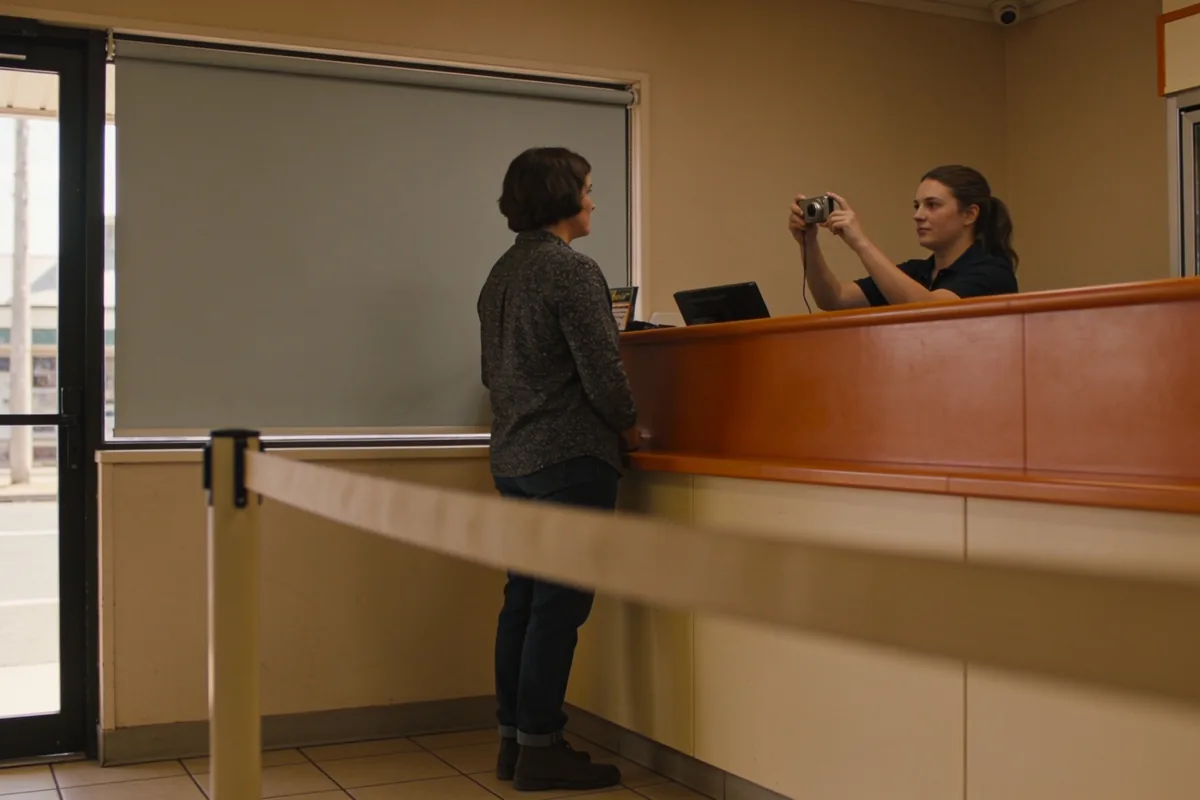
One detail about timing at the counter matters for anyone paying for speed. Under Passport RAPID, which DFAT describes on its urgent travel page, an application lodged before 12 pm on a business day reaches DFAT the same day. For a Fast Track or Priority application, a morning visit keeps a day off the clock.
Two things people do not expect
The first concerns the old passport. DFAT states that the current passport is generally cancelled when the renewal is lodged, and that any remaining validity does not carry over to the new one. Two consequences follow.
- In the general case you cannot keep travelling on the old document while the new one is processed, so lodging in the middle of a busy run of travel leaves a gap with no usable passport.
- The months still left on the old passport are not added to the new one, so there is nothing to gain by waiting for the expiry to come closer before renewing. There is only the risk.
The second is the passport number. A renewed passport carries a new number, and DFAT is explicit that it changes. Flight bookings and visas recorded against the old number need updating with the new details, and a mismatch between the passport you hold and the passport on the booking is far easier to fix from home, weeks out, than on the day. A short list of every booking and visa made on the old passport, written before you lodge the renewal, turns the update into a single sitting once the new passport arrives.
Before you book the flights
The check takes a minute and is best done before any money changes hands. Take the return date, add six months, and compare it with the expiry on every passport in the travelling party. If any passport fails, renew it now on the routine service and keep the $107 or $308 that a late application would otherwise cost. Then confirm the rule for each country on the itinerary on its Smartraveller page, because six months is common rather than universal.
Once the passport is settled, the rest of the trip admin follows the same principle of dealing with the known costs early, through to hiring a car without the extra fees. The passport is simply the one item on the list whose deadline is set by someone else.
One limit, stated plainly to finish. The fees and timeframes here are DFAT’s figures as published on the dates given, and DFAT revises them; its fees and processing-times pages are the places to confirm both on the day you apply.
Sources: Australian Passport Office, Fees (https://www.passports.gov.au/help/fees); Australian Passport Office, Processing times (https://www.passports.gov.au/help/processing-times); Australian Passport Office, Urgent travel (https://www.passports.gov.au/help/urgent-travel); Australian Passport Office, Adult passport (https://www.passports.gov.au/adult-passport); Smartraveller, Indonesia travel advice (https://www.smartraveller.gov.au/destinations/asia/indonesia)