Style & Beauty
The Number on the Sunglasses Label Matters More Than “Polarised”
Sunglasses sold in Australia carry a lens category from 0 to 4. What it means, why polarised is about glare rather than UV, and the pair not to drive in.

Walk past any sunglasses stand at the start of summer and one word does most of the selling. It is on the sticker, the swing tag, the cardboard display and the shop assistant’s first sentence. Polarised. It is a real feature, it does something useful, and it is the word on the label that tells you least about whether the glasses protect your eyes from UV.
So here is the position this article argues. Polarised is about glare. The lens category is about the job the glasses are built to do, including how much sun they block, and in Australia that category is printed on every pair by law. The shops lead with the first word because it sells. You should read the number, because it is the rating.
This piece runs in a deliberate order: the rule that puts the number on the label, what each number means, what polarisation does and does not do, which category suits which day, and finally the one pair you should never wear behind the wheel. (If you came here from the summer style shelf, somewhere between the swimwear and the fake tan that has to last the week, the label is the part of the glasses worth thirty seconds of your attention.)
The rule behind every label
Sunglasses in Australia are not a free-for-all, whatever the bargain bin at the servo suggests. According to the ACCC’s Product Safety Australia, a mandatory safety standard has applied since 1 July 2019: the Consumer Goods (Sunglasses and Fashion Spectacles) Safety Standard 2017, which is based on the Australian and New Zealand standard AS/NZS 1067.1:2016.
It applies to all sunglasses and fashion spectacles sold here. ARPANSA, the federal radiation safety agency, confirms that the standard covers polarising, photochromic and gradient lenses as well as ordinary tinted ones. In other words, the polarised pair on the stand is held to exactly the same labelling rule as the plain pair beside it.
The rule on labelling is specific, and it is the part worth memorising. Under the standard, as the ACCC describes it, the label must show: the name of the supplier, the lens category number, a description of that category, information on how the glasses should be used, and any warnings that apply. The ACCC also says the label must not be covered by a price sticker. If the number is hiding under the price, the shop has got it wrong, and asking to see the label is entirely reasonable.
The five categories, in the ACCC’s words
The category number runs from 0 to 4. The ACCC’s descriptions are short, so here they are, without decoration.
| Category | What the ACCC says it is |
|---|---|
| 0 | Fashion spectacles, not sunglasses |
| 1 | Fashion spectacles, not sunglasses; not suitable for driving at night |
| 2 | Medium glare reduction, good UV protection |
| 3 | High glare reduction, good UV protection |
| 4 | Very high glare reduction, good UV protection; not suitable for driving and road use |
Two things jump out once the table is in front of you.
The first is that categories 0 and 1 are not sunglasses at all, in the regulator’s own description. They are fashion spectacles. A light tint that looks the part on a shop mirror may be sitting in this bracket, and the label is the only thing that will tell you.
The second is that from category 2 upwards the UV description stays the same (“good UV protection”) while the glare reduction climbs. The higher numbers are about how much light and glare the lens cuts, which is a question of comfort and the conditions you are in. It is the category system, not the word “polarised”, that tells you the glasses are sunglasses in the first place.
What polarisation does, and what it does not

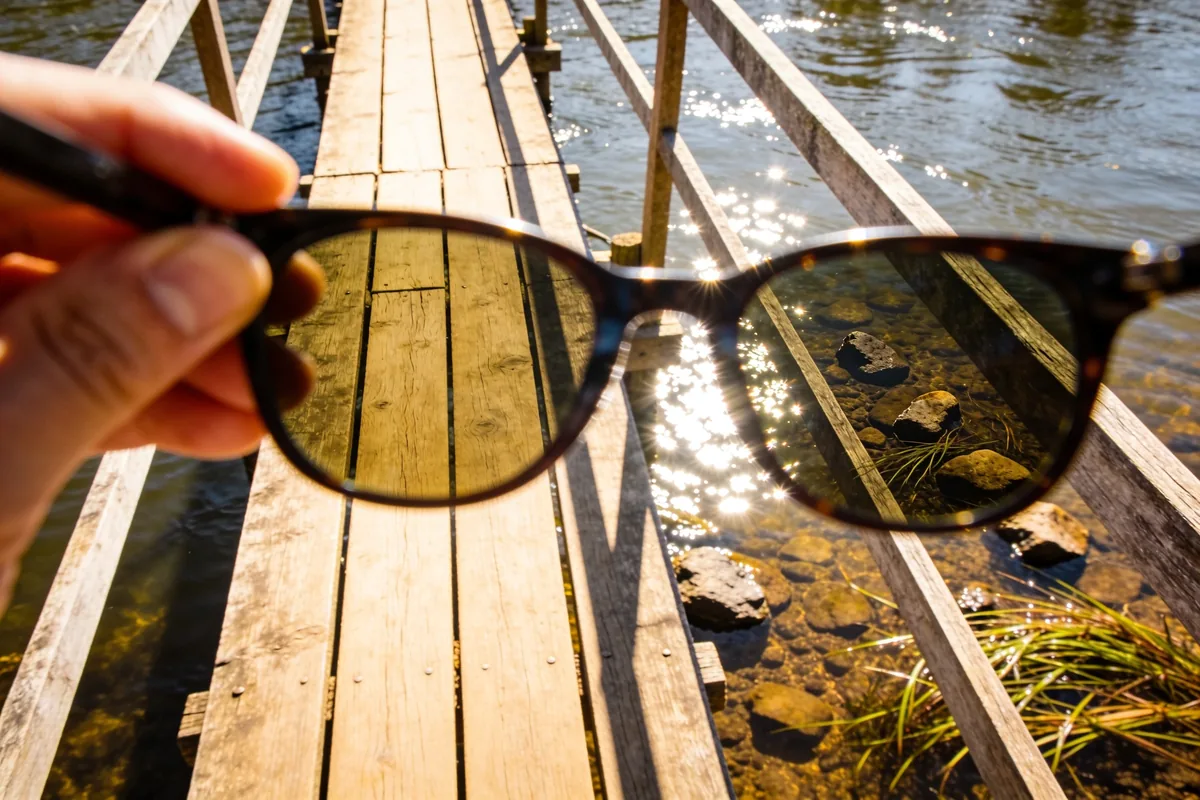
Now the word on the sticker. ARPANSA’s explanation is plain: polarised lenses reduce glare from reflective surfaces, and they can ease eye strain. Anyone who has looked at a river on a bright day with and without them knows the effect, because the white sheet of reflection drops away and the water underneath appears.
That is a genuine benefit. It is also a separate thing from UV protection, and here is where the marketing quietly runs two ideas together. ARPANSA states that UV protection comes from the UV-absorbing properties of the lens material. It does not come from the colour of the lens or its tint, and a darker lens is not necessarily a more protective one.
So the polarising film handles glare, the lens material handles UV, and the tint handles how dark the world looks (three separate jobs, of which the sticker mentions exactly one, and rarely the one that matters most for your eyes in an Australian summer).
The position, then: buy polarised when the job involves water, roads or glare, which is often (fishing, boating, long drives into the afternoon sun). Never buy it as a proxy for UV protection. The proxy for UV protection is the category on the label.
That settles the question people keep asking online, which is whether polarised is worth having or mostly marketing. It is both, and the two halves are easy to separate. The feature is real: on water and on a bright road it changes what you can see. The marketing is the suggestion, made by placement rather than by any claim, that the word on the sticker is the protection. It is not, and nothing in the standard says it is. A polarised pair still has to carry a category like every other pair, and a polarised lens in a category that does not suit your day is the wrong pair, however well it handles glare.
One more test for the stand. If two pairs carry the same category and fit you equally well, the polarised one is the better buy only if you spend time near glare. If you do not, you are reading the wrong line on the label.
Which category for which day
This is where the number earns its keep, because the right one depends on where you will be wearing them.
ARPANSA recommends categories 2 and 3 for everyday use. That covers the commute, the school run, the weekend at the park and most days at the beach. Category 4 is for high-glare settings: at sea, on snowfields, in deserts and in the mountains, where the light bouncing off water, snow or sand is intense enough to justify the darkest lenses. If you are packing for the slopes, put the category 4 pair in the bag alongside the rest of the kit (our guide to what a first Australian snow trip costs covers the remainder of the list).
The Cancer Council adds a point that the category number does not cover on its own: fit. It recommends close-fitting, wraparound styles that meet the Australian standard, in categories 2, 3 or 4. A lens with an excellent rating does less good if sunlight is pouring in around the sides of a small, flat frame. Coverage is part of protection, and it is the part you can judge in a mirror.
Three illustrations make the point better than another rule. They are made-up shoppers, not case studies.
The first wants a pair for the drive to work and weekends in the park. Category 2 or 3, as ARPANSA recommends, close-fitting, and polarised only if road glare bothers her. The word on the sticker is optional for her. The number is not.
The second is heading out on a boat for the day. Glare off the water is the whole problem, so polarised earns its place here, and the sea is one of the high-glare settings where ARPANSA points to category 4. He will need a different pair for the drive to the boat ramp, which is the subject of the next section.
The third has found a light, pretty tint in the bargain bin and assumes it does the job because it is tinted. Check the label. If it says category 0 or 1, the regulator’s description is fashion spectacles, not sunglasses, whatever it looks like in the mirror.
The driving pair
There is one pair you should not drive in, and the label will tell you which.
Category 4 is, in the ACCC’s own wording, not suitable for driving and road use. The very high glare reduction that makes it ideal on a snowfield makes it too dark for the road, where you need to see what is in the shadows. Category 1 is not suitable for driving at night. And ARPANSA adds a related caution: very dark or strongly coloured lenses can affect your ability to see traffic signals properly, which is the last thing you want at an intersection.
The practical answer for most drivers is a category 2 or 3 pair, polarised if the glare off the road and other cars bothers you, kept in the car and not swapped for the snow pair because it happened to be nearer the door.
Read the swing tag before the price tag
The check takes about half a minute at the stand, and the order matters.
First, the category number. Find it on the label (and if a price sticker is sitting on top of it, ask). For everyday wear, look for 2 or 3. For snow, water or desert, 4. Never 4 for driving.
Second, fit and coverage. Close-fitting and wraparound, as the Cancer Council recommends. Light should not be leaking in at the sides or over the top.
Third, polarisation, if the job needs it. Water, roads, glare: yes, it is worth having. For anything else, it is a nice extra. It is never the rating.
The sticker will keep shouting the word it was designed to shout. The number on the label is the rating, and it is printed there by law for a reason.
Sources: Sunglasses and fashion spectacles mandatory standard, ACCC Product Safety Australia (https://www.productsafety.gov.au/standards/sunglasses-fashion-spectacles); Sun protection using sunglasses, ARPANSA (https://www.arpansa.gov.au/understanding-radiation/radiation-sources/more-radiation-sources/sun-protection-sunglasses); Fact sheet: Eye protection, Cancer Council Australia (https://www.cancer.org.au/about-us/policy-and-advocacy/prevention/uv-radiation/related-resources/fact-sheet-eye-protection)