Home & Garden
Swapping Gas for Induction Starts at the Switchboard, Not the Cooktop
Swapping a gas cooktop for induction can mean a dedicated circuit or a switchboard upgrade. What to check first, which pans work and what Victoria now requires.

The cooktop is the cheap decision. The circuit behind it is the expensive one.
Most households leaving gas spend weeks comparing induction cooktops and about five minutes thinking about the wiring. That order is backwards. Any decent induction unit will boil water faster than the burner it replaces and wipe clean in seconds. Whether the house can power it without new cabling, a new breaker or a new switchboard is what decides the final bill, and only an electrician can answer that.
So the order of operations is fixed. Electrician first. Benchtop second. Pans third. Cooktop last.
Why the circuit matters
An induction cooktop draws serious current. Energy Victoria’s buyers guide puts typical cooking zones at between 1,600 and 3,000 watts each, with boost functions pushing a single zone above 4,000 watts. Run three zones for a Sunday breakfast and the load adds up fast.
The consequence is stated plainly in the same guide. Most good-quality induction cooktops need more than 15 amps, which is above what common residential power circuits are built to supply. They are usually hardwired by a licensed electrician, and the job may involve running a new dedicated circuit from the switchboard, or upgrading the switchboard itself if there is no room or capacity left in it.

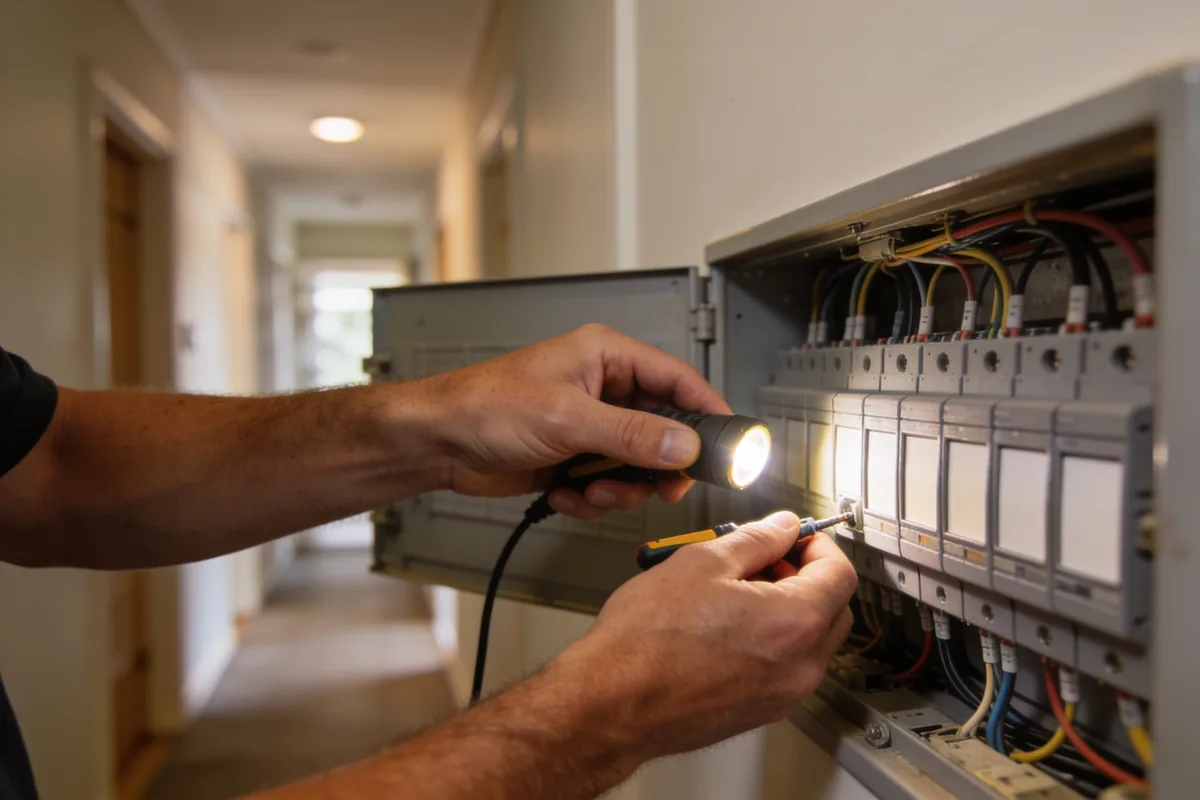
That is the variable that moves the price. A house with a modern board and a spare circuit already run to the kitchen, perhaps left over from an old electric oven, can be a short job. A house with an older board, no spare capacity and a kitchen at the far end of the hallway is a different job altogether. Same cooktop, very different invoice.
Two pieces of reassurance from the guide. Single-phase power is adequate for most homes. Three-phase is rarely needed. Anyone told otherwise should ask why.
Then there is the claim that circulates online: that you can replace a gas stove with induction and plug it into a normal wall outlet. Partly true. Some plug-in models exist, and YourHome notes that lower-power induction models are available. Energy Victoria adds the catch: a plug-in unit on a shared circuit can trip it when other appliances are running at the same time. A cooktop that cuts out whenever the kettle and the dishwasher run is a poor trade for a cheaper installation. The plug-in route suits some kitchens and some cooks. It is a compromise, and it should be chosen as one.
Pans: the magnet test
Induction heats the pan, not the glass. It does that through magnetism, which means the pan has to be made of something a magnet will stick to.
YourHome lists what works: cast iron, mild steel, and most stainless steel, though not all of it. The base has to be ferrous. Anything else stays cold. Plenty of pans are sold with an induction symbol on the base. Where there is no symbol, the test costs nothing. Hold a fridge magnet to the bottom of the pan. If it grips firmly, the pan will work. If it slides off or barely holds, it will not.
Run that test across the whole cupboard before buying anything. Most kitchens turn out better than expected. Cast-iron frypans and many stainless saucepans pass easily. The failures tend to be the old aluminium stockpot and the non-stick pan that came free with something.
Two more points from YourHome. Match the pan to the zone, because a small pan on a large zone wastes most of the zone. And a round-bottomed wok will not sit properly on flat glass. The options are a flat-bottomed wok or a cooktop with a dedicated sunken wok zone. Anyone who cooks stir-fries most nights should settle this before choosing the model, not after.
The pan bill is real but bounded. Replace what fails the magnet test, and only what gets used.
The benchtop cut-out
The hole in the benchtop is the other hidden constraint, and it bites hardest in renovated kitchens.
YourHome points out that induction cooktops come with clearance dimensions that must be respected, and that matching a new unit to the cut-out left by an old gas cooktop can be difficult. Gas and induction units rarely share exact dimensions. A new cooktop slightly larger than the old hole means cutting the benchtop. A smaller one means filling a gap.
Then the material question. YourHome notes that engineered stone may no longer be cut, which means the existing cut-out in an engineered stone benchtop cannot simply be enlarged. A household with that benchtop is choosing from the cooktops that fit the hole it already has, or it is choosing a new benchtop. Those are very different budgets.
Measure the cut-out. Write the dimensions down. Take them shopping. A cooktop that does not fit the hole is the most expensive cooktop in the shop.
What Victoria’s rules require
A good deal of the pressure to switch comes from a vague sense that gas is being banned. In Victoria, the rules are specific, and they mostly concern new homes and hot water.
According to Planning Victoria’s information on the state’s Gas Substitution Roadmap:
- from 1 January 2024, new gas connections are being phased out for new homes that require a planning permit, under planning scheme amendment VC250 and clause 53.03
- from 1 January 2027, all new homes must be built all-electric
- from 1 March 2027, gas hot water systems in existing homes must be replaced with an electric system at the end of their life
- there is no change to existing gas cooking in existing homes
That last line is the one that matters for this decision. Nobody is forcing the cooktop out of an existing Victorian kitchen. The gas cooktop that works today can keep working.
The reason to move, then, is the household’s own: easier cleaning, a cooler kitchen in summer, or a plan to take the whole home electric over time. The last of those is where the hot water rule becomes relevant, because a house replacing its gas hot water with electric is one step closer to having the cooktop as its only gas appliance. Draught-proofing and efficient heating tend to sit in the same plan; our guide to finding where your heat escapes covers the cheapest part of it.
Make the decision for your own reasons. The rule people fear does not exist for existing kitchens.
The cost, honestly
The total has three parts. The cooktop. The electrical work. Any replacement pans.
The cooktop is the part that gets compared. Prices vary widely between models, but it is the most predictable line on the bill because it is on a price tag. The pans are the smallest part for most households, once the magnet test has shown how few need replacing. The electrical work is the line that varies most, because it depends entirely on what the electrician finds at the board and along the path to the kitchen. Get that quote first, and treat any cooktop price as incomplete until the quote is in.
Running costs are a separate question and easy to overstate. What a household pays depends on its electricity tariff, what it cooks and how often, so a single per-meal figure would be a guess dressed up as a fact. The same logic applies to every kitchen appliance. Our piece on whether an air fryer is cheaper to run than an oven shows how the answer changes with the cooking itself, and the method carries over.
One question is worth putting to the household’s own bill. Once the cooktop is the last gas appliance in the house, what is the gas connection costing just to stay connected? Look at the supply charge on the next gas bill and set it against how much cooking that connection is supporting. For some households the answer settles the whole decision.
Discounts
Victorian households can access discounts on eligible built-in induction cooktops through the Victorian Energy Upgrades program, which Energy Victoria runs. This article quotes no amounts, because they are set by the program and can change. Check its current conditions before signing a quote, and confirm with the installer that the cooktop and the job qualify.
Outside Victoria, check what your own state offers. Do not assume either way.
One safety line
Energy Victoria advises that anyone with a pacemaker or other medical implant should speak to their doctor before using an induction cooktop. Induction works through a magnetic field, and the question is a medical one, not a sales one. Ask before buying.
Call the electrician first
The sequence is the whole method.
Book an electrician to look at the switchboard and the kitchen circuit. Find out whether the house needs a new dedicated circuit, a switchboard upgrade, or nothing at all. Get that in writing.
Measure the benchtop cut-out, and note what the benchtop is made of. Engineered stone narrows the field.
Run a magnet across every pan. Keep the ones that grip.
Then shop for the cooktop, with the circuit capacity, the cut-out dimensions and the wok question already answered. Skip the brochure comparisons until those three facts are known. They decide more than any feature list.
Induction is a good cooktop. The swap is only as good as the order it is done in.
Sources: Induction cooktop buyers guide, Energy Victoria (https://www.energy.vic.gov.au/victorian-energy-upgrades/products/induction-cooktop-discounts/induction-cooktop-buyers-guide); Appliances and technology, YourHome (https://www.yourhome.gov.au/energy/appliances); Victoria’s Gas Substitution Roadmap, Planning Victoria (https://www.planning.vic.gov.au/guides-and-resources/strategies-and-initiatives/victorias-gas-substitution-roadmap)